
An ex-computer programmer stuns entertainment industry with a blockbuster movie
From TV life to the big screen and millions of dollars in between

Al was a determined young man.
But for the first few years of his adult life, he just couldn’t put his finger on what it was that he wanted to do.
Initially, he planned to become a chemical engineer. So he studied hard during his time at Brooklyn Tech, which earned him a scholarship to City College of New York.
But somewhere along the way Albert Ruddy decided being an architect was a better choice.
So he enrolled in of all places … a school located 2,917 miles from where he lived: The University of California’s School of Architecture.
He eventually graduated with a degree in hand but instead of getting a job related to that industry, he went to work for the Rand Corporation where he served as a programmer trainee for a few years.
But he hated it. There was nothing creative about his new job.
So he decided right then and there, he’d like to be a writer. Heck since he was already living in Los Angeles, considered “the entertainment Capital of the world,” Al managed to get a job as writer for Universal Studios, on the television side of their business.
This marked the start of his life in the entertainment business.
His First Movie was a Flop
I can’t say for sure whether it was his writing or charismatic personality, but Marlon Brando Senior (the father of the legendary actor Marlon Brando) was intrigued enough with Al that he asked him to serve as producer for the movie Wild Seed.
It’s about a girl who runs away from her East Coast home, heads to California to meet her biological father. On her road trip, she is befriended by a drifter who travels with her, acting as her protector.
Al had never worked on film before, but he was willing to give it a try. After several months of production, the movie debuted in 1965. Unfortunately it was not the hit he was hoping it would be. In fact the movie was an immediate flop at the box office.
Now remember, Al is a determined guy. One flop of a movie wasn’t going to set him back in the least.
But he did go back to New York, which turned out to be a smart move because he landed a job as writer for CBS Studios.
At the time, the studio executives had an idea for a new series that would focus on the lives of prisoners in American prison. It seemed these types of shows were popular back in the early part of the 1960’s.
But Al was weary of working on the show particularly when he found out that rival station NBC already had a show in production called Campo 44, which was about life in a prison in Italy.
Al knew whatever prison show CBS put out, it had to be something different … something so unusual viewers couldn’t help but tune in.
His First Success
So Al pitched the idea of making the show about a gang of prisoners in a German war camp during World War II. But these wouldn’t be ordinary prisoners.
Nope, this gang had a leader … Colonel Robert Hogan who along with five other members ran covert missions right inside the German camp. Much of what they did would go undetected from the two men who ran the facility — Colonel Klink and Hans Schultz.
The title for Al’s new show: Hogan’s Heroes.
Needless to say the show was a huge success, airing from 1965 to 1971. And it won back-to-back Emmy awards in 1968 and 1969.
After the series concluded, Albert Ruddy went back to producing movies because he found working on television shows boring. He once explained to a friend how he thought about movies, “It’s about the experience. You can’t get that in television. You’re sitting in your living room looking at a fucking box.”
Ruddy’s next film was entitled Making It, which was released in 1970. It didn’t do all that well. But our guy Al’s determination kicked in once again. So he made his third movie, Little Fauss and Big Halsy starring Robert Redford and Lauren Hutton.
While it wasn’t a flop, it wasn’t a huge hit.
Money Out of His Pocket
Al was now making a name for himself in Hollywood but as a producer of low-budget films. And that’s how he got his next movie project.
Except this one would stun the entertainment industry.
Paramount Pictures had just acquired the rights to Mario Puzo’s novel The Godfather. They wanted to turn it into a movie and set a budget of roughly $6 million.
They didn’t expect much out of their little film, which is they asked Al to be the producer. They paid him $150,000 and made sure he understood not to go over budget. Because if he did, it was money out of his pocket.
Al agreed but with one condition … the film shouldn’t be made in the same way that all other mobster movies were done. In fact Al’s idea was to make the film more about family than the mafia.
He wanted the audience to relate to each character, giving them distinct personalities. Although executives at Paramount were doubtful his idea would work, they let Al make the film his way.
A Huge Box Office Success
Good thing they listened to Al because when The Godfather was released in 1972, it was the highest grossing film of that year, bringing in over $135 million in the U.S. alone. That’s about $711 in today’s money.
And it swept the Academy Awards receiving awards for Best Actor, Best Picture, Best Adapted Screenplay, three Best Supporting Actors, Best Director, Best Original Score, Best Costume Design, Best Sound Mixing and Best Film Editing.
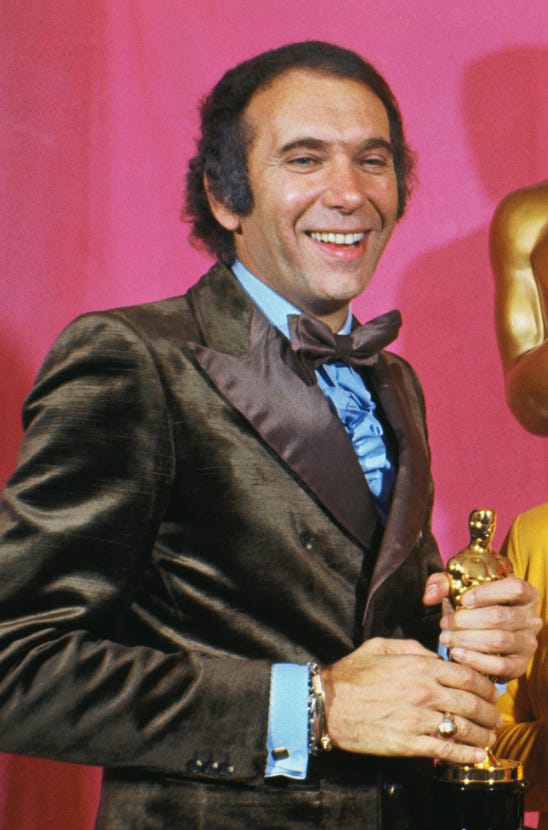
With this win, Al was no longer considered a low-budget producer. He was the producer everyone wanted to work with on movies. In fact his next film The Longest Yard, grossed over $191.5 million. It won the Golden Globe for Best Motion Picture.
Al was on a roll. His next big motion picture was Million Dollar Baby, starring Clint Eastwood and Hilary Swank. It was released in 2004 and grossed over $100 million. It won the Academy Award for Best Picture, Best Directing, Best Actress, and Best Supporting Actor.
So what was Albert Ruddy’s one good idea? For him, it was thinking differently, especially when everybody else is pushing you to do “the norm.” If he had not thought of a different story plot for Hogan’s Heroes or different way to film a mafia movie … he wouldn’t have had such a successful career.
It’s ok to be different because that’s how you stand out.
Awesome Quotes by Awesome People
“Better to embrace the discomfort of being different than the comfort of fitting in.” —O. David Emenike