
After Losing Everything, He Noticed One Strange Detail on a Coal Railway
That overlooked moment became the foundation of the modern roller coaster industry.

Not so long ago, in the rugged mountains of eastern Pennsylvania coal was king. I’m talking Anthracite coal—hard, clean-burning, and prized for fueling America’s growing industries.
It was discovered near Summit Hill in the early 1800s but getting it down the steep slopes to the Lehigh River at Mauch Chunk for shipment was no easy task.
So sometime between 1818 and 1819, the engineers working for the Lehigh Coal & Navigation Company designed a stone-paved road with a consistent gentle grade to help ease the coal down to the canal. Called the “wagon road,” it was far sturdier than a dirt trail, allowing consistent, year-round use even in bad weather.
Of course it was the miners that had to actually make the road, which had a downward slope all the way from the high elevation where the mines were located to the river below. The slope was roughly a 75 to 100 feet drop per mile (roughly a 1.4% to 1.9% grade, or about 4-6% in some accounts of the full system).
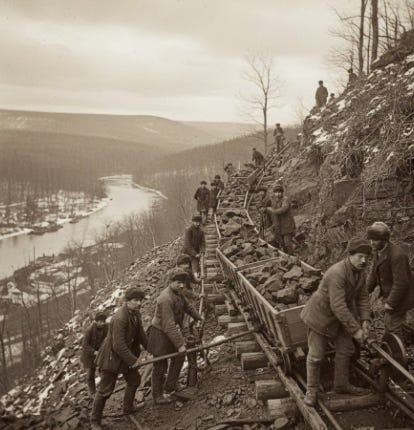
That angle allowed loaded coal wagons to roll downhill mostly by gravity with minimal braking or animal power needed, making transport faster, cheaper, and more efficient than traditional bumpy, uneven mountain paths or canals alone.
But getting the coal back up that slope … well that was a slow uphill battle. Teams of mules were used to tow the empty wagons back up the 9-mile stretch. It took about 30 minutes to fly down the mountain, but roughly 3 to 4 hours for the mules to pull the cars back up.
Interestingly, the mules didn't walk down—they actually rode the train down in special "mule cars" to save their energy for the climb.
And users—coal mining companies— had to pay a fee or toll, which was the standard way to fund and maintain such infrastructure in the early 1800s. The idea was revolutionary for the time: it turned a rugged mountain haul into a controlled, almost “gravity-assisted” delivery system.
However just a few years later, the engineers made improvements to their “wagon road,” which made getting the coal down to canal even faster and more efficient.
They simply laid wooden rails topped with iron straps right on top of the existing stone-paved roadbed to create the full gravity railroad—coal cars could now coast even more smoothly and quickly under gravity alone.
But as coal production ramped up and efficiency demands grew, the company expanded the system sometime around 1844–1846. They added a separate “back track” (return route) for the empty cars, creating an 18-mile figure-8 loop overall.
To get the empties back up the steep sections without mules, they installed two stationary steam-powered inclined planes. These used cables or chains to pull the cars uphill.
At the top of each incline, the track included a Y-shaped switch (a “wye” or turnout) where the car would arrive from one direction, then be switched (manually or mechanically) to the opposite leg of the Y to reverse direction and head back downhill on the return path.
This reversal—essentially “switching back” the car’s direction—was the core mechanic that gave the whole system its nickname: Switchback Railway.
While the Switchback Railway worked wonders for the coal mining industry one young man saw something else in this mechanical marvel. He saw how it could deliver excitement and a sense of thrill for people not working in the mines. And then went about making improvements to the cars and the track.
In the end, what he created would eventually dwarf the coal industry that inspired it. He realized that while coal fueled the engines of the era, adrenaline could fuel an empire … one that is valued at approximately $95 billion to $117 billion in annual sales.
I’ll tell you more about the industry he pioneered but first let’s talk about his other invention—one that ruined his health and left him penniless.
Your Seams Are Showing
Stockings have been around for years … hundreds of years. What might surprise you to know is they started out as coverings for men’s legs, not for women.
In fact back in ancient Egyptian times, men were “socks” that were made of knitted wool with a split toe to be worn with sandals. In the Middle Ages, men wore "hose" made of woven cloth (like linen or fine wool). Since the fabric wasn't stretchy, they were baggy and had to be held up by garters or tied to undergarments.
By the 1500s knitting technology improved. Queen Elizabeth I famously received her first pair of black silk stockings in 1560 and allegedly vowed never to wear cloth hose again because silk was so much softer and stretcher.
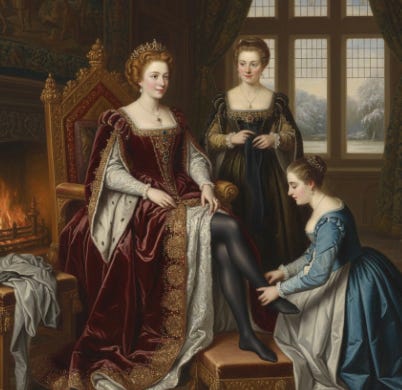
But for most women, silk wasn’t an option. Their stocks were made from worsted wool (a fine smooth yarn) or heavy woolen yarns. The stockings were thick, warm, and durable, but not exactly "elegant." And they were made with a machine known as the flat-bed knitting frame.
Basically the machine would knit a flat, T-shaped or leg-shaped piece of fabric. To ensure the stocking fit snugly at the ankle but widened at the calf and thigh, the knitter had to manually drop or add stitches (a process called "fashioning").
Once the flat piece was finished, it was removed from the frame. To make it wearable, the two edges were folded together and sewn by hand (or later by machine) from the toe, under the foot, and all the way up the back of the leg, creating a long seam.
However the seams could be uncomfortable (irritating the skin, especially during long wear), prone to ripping, or visible under clothing, which was a practical and aesthetic drawback in Victorian-era fashion where stockings were essential undergarments (often wool, cotton, or silk for modesty and warmth).
One young entrepreneur, LaMarcus Adna Thompson just happened to notice that the seams weren’t what women were craving. LaMarcus was born in 1848 in Jersey, Ohio, to Adna and Nancy Thompson. He was one of several children and moved with his family to a farm in Hillsdale County, Michigan, when he was just three years old
He showed early inventive talent as young as 12 years old. He successfully built a butter rotary churn and an ox cart for his father. By age 17, he had mastered carpentry as an apprentice.
In the winter of 1866, he enrolled at Hillsdale College in Michigan. He was part of the English preparatory department. However because he had to pay for his own education and couldn’t afford to continue, so he dropped out and moved to Elkhart, Indiana.
He got a job working for a local grocery story. And while working here, he probably realized rather quickly that hosiery was a high-demand, profitable item and that seamless production could disrupt the market by offering a superior product: more comfortable, longer-lasting, and easier to manufacture.
So at age 19 he designed and built a specialized knitting machine capable of producing seamless stockings and tights. His innovation was a machine that could knit tubular, seamless forms directly—essentially creating a continuous, tube-shaped stocking without the need for seaming.
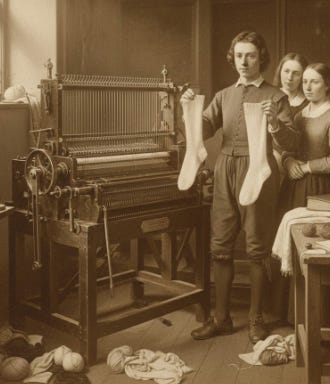
Sources describe it as a “knitting machine that manufactured seamless hosiery,” likely an adaptation or improvement on circular knitting principles (which had existed in rudimentary forms since the 16th century but were not widely industrialized for fine stockings).
He started by creating handmade samples to demonstrate the concept, then built the machine to scale production. This allowed for smoother, more comfortable, better-fitting stockings that were quicker and cheaper to produce at volume.
The result of his work? LaMarcus founded the Eagle Knitting Company, which became very successful. So much so that he “made a fortune” from it in his 20s and early 30s.
Rich But Not Rich
Unfortunately, the intense work of building, running, and scaling the business took a toll on LaMarcus. In truth the stress led to a severe health breakdown (described as a “nervous breakdown” or general exhaustion), forcing him to sell the company while still in his mid-30s.
This setback left him broke and in poor health, but it also did something else … freed him to travel while recovering from his breakdown. And one of the places he traveled to was Lehigh River at Mauch Chunk.
Here he saw the Switchback Railway hauling coal up and down the mountain. But he also saw that on off days, the railway became a tourist attraction.
Miners and locals had already hopped on for joyrides during off-hours, but now tourists flocked into the area. For a small fee, visitors boarded the same sturdy coal cars—now fitted with benches—and experienced the exhilaration of plummeting down steep grades at up to 50 mph in places, wind whipping through their hair, the countryside blurring by.
It was hair-raising, scenic, and addictive. By the 1870s, the line had shifted almost entirely to passenger service, drawing as many as 75,000 riders a year—second only to Niagara Falls as a U.S. tourist draw. People called it the “Switzerland of America,” a wild, gravity-fueled adventure that turned an industrial tool into an early thrill ride.
LaMarcus wanted to experience that same thrill, so he took a ride on the Switchback. And he enjoyed every minute of it. That’s also when a certain sensation began to brew deep inside: the simple power of gravity delivering excitement without engines or complexity.
So he thought, why not shrink and refine this concept for pure amusement—something safe, wholesome, and accessible for all tourists, not just those wanting to go up and down the mountain. His idea was simple: a way for tourist to enjoy the same thrill of riding the rails but being able to do so from coast to coast.
You could say it was a eureka moment that blended his engineering savvy with a dash of redemption.
Coasting Fast and Slow
Fresh from selling his Eagle Knitting Company due to his health collapse, Thompson had modest savings but boundless ingenuity. He returned to New York around 1881, sketching designs in his mind.
He drew direct inspiration from the Mauch Chunk’s gravity descent and switchback mechanics—the way cars reversed direction at Y-shaped switches to reuse the downhill momentum.
But he also studied an unbuilt 1878 patent by inventor Richard Knudsen for an “Inclined-Plane Railway,” which proposed a similar elevated track with gravity propulsion for amusement. Thompson refined these ideas: no more breakneck speeds or mule-powered returns. Instead, a compact, controlled ride focused on gentle thrills and scenic enjoyment.
By 1884, he had secured his own patent (U.S. Patent No. 310,966 for a “Switchback Railway” or “Roller Coasting Structure”) and set his sights on Coney Island—a bustling seaside resort in Brooklyn, New York, teeming with crowds but rife with vice.
He chose a prime spot at West Brighton beach, along West Tenth Street from Surf Avenue down to the ocean, paying for the rights to build on this high-traffic land to maximize exposure. Construction was straightforward and low-cost: a 600-foot-long wooden trestle track, elevated up to 50 feet at the starting tower, with undulating gentle hills and a consistent downward grade.
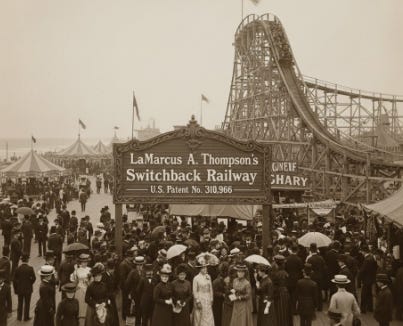
No engines, no loops—just pure gravity pulling bench-like cars (seating passengers sideways for ocean views) at a tame 6 miles per hour. At the end, riders disembarked, attendants manually switched or pushed the cars back up a parallel track via a lift or ramp, and the process repeated. It was bidirectional but not a full circuit—more like a scenic shuttle than today’s scream machines.
The “how” was a mix of grit and clever bootstrapping. Thompson funded it himself with his remaining hosiery proceeds, keeping costs low by using basic materials and his own designs. He pitched it as a “moral” attraction: clean, family-oriented fun amid Coney’s chaos.
Skeptics abounded—who would pay for a slow gravity slide when beer halls were free?—but Thompson persisted, iterating on safety features like side rails to prevent derailments.
On June 16, 1884 (though some accounts say June 13), the Switchback Railway opened to the public. For just a nickel, riders climbed stairs to the top tower, boarded the open cars, and glided down the track, hearts racing from the novel sensation of controlled freefall.
The debut was a smash. Lines snaked for hours as New Yorkers and tourists alike clamored for the experience. It raked in $600 a day—enough to recoup the investment in three weeks—and proved the viability of purpose-built amusement rides.
This wasn’t just an adaptation; it was a transformation. Thompson had shrunk the Mauch Chunk’s industrial-scale gravity haul into an accessible, repeatable thrill, stripping away the danger while amplifying the joy. He went on to patent over 30 more improvements, franchising similar “scenic railways” across the U.S. and Europe, adding tunnels with painted biblical scenes or landscapes to enhance the “wholesome” vibe.
LaMarcus’ Coney Island creation marked the birth of the modern roller coaster industry right there on Brooklyn’s sandy shores. What started as a coal miner’s practical tool in Pennsylvania’s mountains evolved, through Thompson’s vision, into a global entertainment staple—proving that sometimes, the best ideas switch back from utility to pure delight.
His story reminds us that even when life knocks you down—through illness, doubt, or unexpected detours—the spark of creativity can switch directions, turning obstacles into momentum and ordinary ideas into legacies that endure for generations.
Amusement Parks Across the Globe
Today, the global amusement parks industry (often encompassing theme parks, water parks, and traditional amusement venues) is valued in the range of approximately $80–110 billion USD, with projections for steady growth.
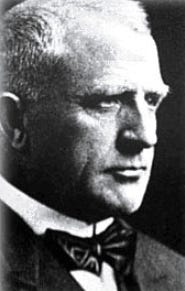
While Coney Island remains iconic for its cultural legacy (as the birthplace of many modern rides via figures like LaMarcus Thompson) and boardwalk vibe, it ranks as a regional/nostalgic spot rather than a top revenue or attendance powerhouse compared to mega-resorts.
Instead the global leaders include Magic Kingdom (17+ million visitors annually), Disneyland, Universal Studios Japan, and others with 10–20+ million attendees each.
Editor’s Note: Most of the stories I write begin with research — with people I’ve never met and lives I come to know only through history. However The Search for Valentina Getsch began differently.
It’s a story close to my heart. A story about my father’s lifelong search for his mother — and how that search revealed something enduring: that hope doesn’t disappear with time, and love can survive across continents, generations, and even silence.
If you’d like to read the full story, the memoir now exists in its complete form and can be found here on Amazon.
Amazing Quotes by Amazing People
“I have not failed. I’ve just found 10,000 ways that won’t work.” — Thomas Edison